

How Many Parts Are in a Car Tail Lamp? A Mold Maker's Breakdown

From the street, a tail lamp looks like a single glowing red surface. Open one up, and you'll find six to ten or more injection molded parts, each with its own material and its own tooling requirements. Howmin has built automotive lamp molds for over 30 years—here is the breakdown from a mold maker's point of view.

The Main Components of a Tail Lamp
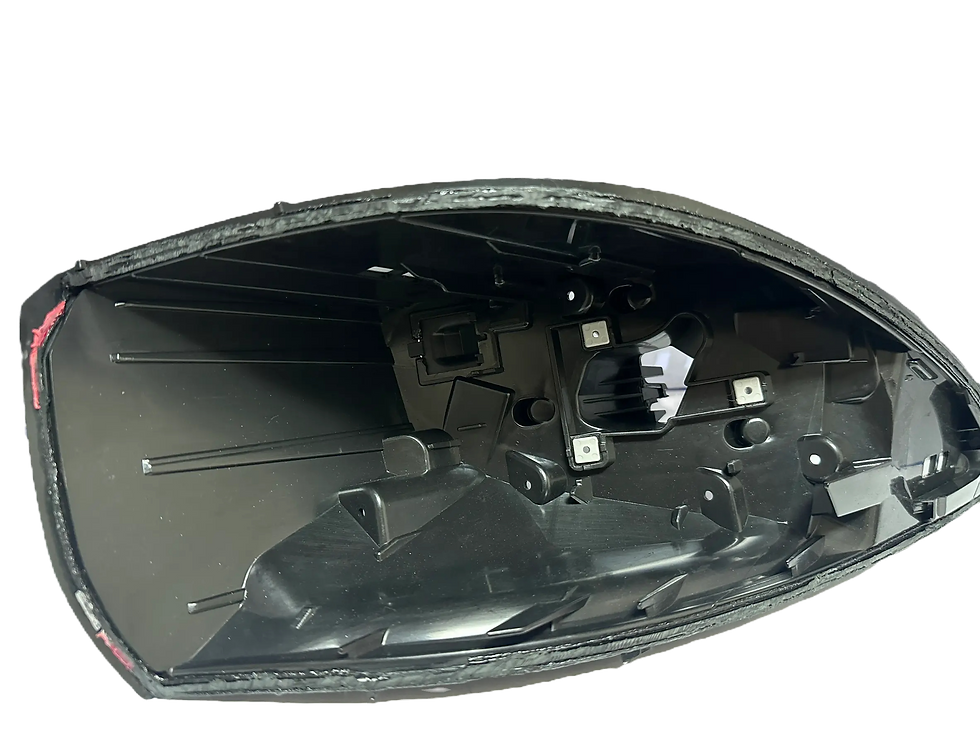
1. Housing
The structural backbone of the entire lamp—it carries every other component and mounts the assembly to the vehicle body. Typically molded in ABS, opaque, with dense snap-fits, screw bosses and rib structures on the back—which, on the mold side, means extensive slide and ejection mechanism design.
2. Lens
The red surface everyone sees. Molded in PMMA (acrylic) or PC, it is both the appearance surface and the optical surface of the lamp—no flow marks, weld lines or sink marks allowed. This is the most demanding part to tool, and the star of multi-shot molding. More on this below.

3. Reflector
Shapes the light source into the beam pattern required by regulation, with a vacuum-metallized mirror surface. The optical accuracy of the mold cavity directly determines whether the lamp passes photometric certification.

4. Light Guide
The core component behind today's full-width tail lamps and light bars: high-clarity PMMA that carries LED light evenly along the entire strip. Light guides are extremely sensitive to mold surface roughness—optical zones demand mirror-grade polishing.

5. Bezel
The visible interior trim frame that separates the optical zones, often metallized or textured.

6. Seals and Small Parts
Waterproof gaskets, vent valves, wire harness clips, LED PCB brackets—small parts, but miss one and the lamp leaks or fogs up.
The Key Point: Why the Lens Needs a 2K/3K Multi-Shot Mold
Look back at component #2. A single tail lamp lens often needs a red zone (stop/tail light), a clear zone (reverse light), and an amber zone (turn signal)—three colors, yet it remains one part.
The traditional route is molding the colors separately and assembling them, or applying secondary processing to a clear part—with weaknesses at every joint: sealing integrity, light transmission consistency, and long-term weathering. A 2K/3K multi-shot injection mold—also known as bi-injection or multi-component tooling—molds all colors of that one part in a single mold, within a single molding cycle: the different PMMA materials fuse inside the mold, producing a sealed, seamless interface and a finished appearance straight out of the press, with no downstream assembly of the lens.

This is also where the technical barrier of multi-shot tooling lives: alignment precision between multiple core sets, shrinkage compensation across different resins, and rotary/transfer mechanism design. Get any one of these wrong, and the color boundary shows flash or mismatch—exactly where the customer's eye goes first. Howmin has delivered over 2,990 molds since 1994 and is one of the few mold makers in Taiwan capable of stable four-shot (4K) automotive lamp molds.
One Tail Lamp—How Many Molds?
At minimum, as many molds as there are parts: one for the housing, one for the lens (a 2K/3K tool if multi-color), one each for the reflector, the light guide, and the bezel. A tail lamp development program is typically a package of five or more molds, with interlocking deadlines. That is why lamp manufacturers prefer a tooling partner who handles design, mold flow analysis, 5-axis CNC machining and die spotting under one roof—fewer interfaces, clear accountability, controllable timing.
FAQ
Q: Why is PMMA used for tail lamp lenses instead of PC?A: PMMA offers higher light transmission and better weathering resistance (less UV yellowing), making it the mainstream choice for lens appearance surfaces; PC is tougher and used where impact strength matters. Their different shrinkage rates are exactly one of the variables 2K mold design must compensate for.
Q: How long does a 2K tail lamp lens mold take to build?A: Depending on size, cavity count and optical surface complexity, typically about 3–4 months; a firm schedule is confirmed at quotation based on the part structure.
Q: Can Howmin build just one mold from the lamp set?A: Yes. We take on single molds as well as complete lamp tooling packages—both include mold flow analysis and mold trial validation.


