


Production Process
Howmin Co., Ltd. provides a fully integrated one-stop development process for automotive lighting injection molds.
From mold design, CAM programming, 5-axis CNC precision machining, and EDM (Electrical Discharge Machining), to mold assembly & validation and final fitting using a vertical die spotting machine, all seven key manufacturing stages are completed entirely in-house.
Automotive Lighting Mold Development Process – 7 Key Steps in Plastic Injection Mold Manufacturing
Step 1:Mold Design
During the automotive lighting mold design stage, Howmin utilizes Siemens UG/NX CAD/CAE software for advanced digital simulation. From initial concept development to manufacturability verification, this process significantly reduces development risks in mold production. Design data is seamlessly integrated with our in-house machining team, enabling precise control over mold structural strength, rigidity, and manufacturing cost. This ensures that every mold component achieves optimal cost-performance ratio and production stability before mass production. At this stage, we also carefully evaluate multi-shot mold configurations (2K/3K/4K), including parting line design and material compatibility, laying a solid and accurate foundation for subsequent machining processes.
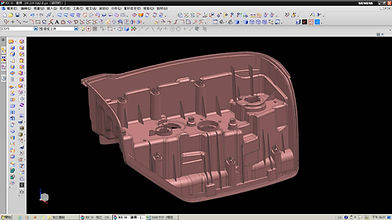
Step 2:Mold Splitting & Flow Analysis
Howmin utilizes Siemens UG/NX for 3D mold splitting design and mold flow analysis (MFA) through advanced digital simulation. By integrating the optical surface requirements and structural characteristics of automotive lighting products, we efficiently determine critical design elements such as parting lines, cooling channel layout, gate locations, and runner systems. Through rapid iteration between mold structure optimization and manufacturability validation, we effectively reduce the number of trial runs and shorten the plastic injection mold development cycle. This ensures that every automotive lighting mold meets the highest standards of precision, stability, and mass production quality.

Step 3:CNC Toolpath Programming
Howmin utilizes advanced CAM software for 5-axis CNC toolpath simulation and program generation. Through dynamic simulation, we proactively detect and eliminate risks such as tool interference and overcutting, ensuring safe and accurate machining before actual production begins. By optimizing cutting parameters and refining toolpath strategies, we significantly improve machining efficiency and achieve superior surface finish quality. Every toolpath is precisely controlled to meet high standards of precision, stability, and mass production reliability. This approach is especially critical for manufacturing deep-cavity molds and multi-shot injection mold components, ensuring consistent performance in complex automotive lighting mold applications.

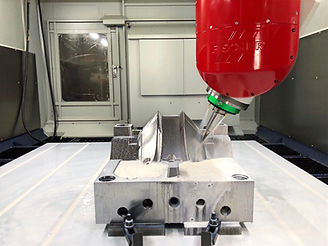
Step 4:5-Axis CNC Machining
Howmin utilizes large-format 5-axis CNC machining centers, combined with dynamic toolpath simulation and cutting parameter optimization, to achieve high-precision tolerance control and stable machining performance. By completing complex multi-angle and freeform surface machining in a single setup, we significantly reduce tool changes and positioning errors, ensuring superior machining consistency. This advanced machining capability effectively shortens the plastic injection mold development cycle and reduces manufacturing costs. It is especially suitable for deep-cavity molds, multi-shot injection molds, and other high-precision components required in automotive lighting mold production.
Step 5:Electrical Discharge Machining
Howmin utilizes advanced EDM (Electrical Discharge Machining) technology to precisely remove material through high-frequency electrical sparks between the electrode and the workpiece. This process generates no mechanical stress, making it ideal for machining complex geometries and fine details in automotive lighting molds. Our facility is equipped with dual-head EDM machines, allowing two electrodes to operate simultaneously for synchronized machining. This capability reduces overall machining time by up to 40%, significantly improving production efficiency and ensuring stable delivery schedules. This process is essential for achieving the high precision required in automotive lighting molds and multi-shot injection mold components.

Step 6:Mold Assembly & QC
Before mold assembly, Howmin’s experienced technicians use pneumatic polishing tools to perform fine finishing on CNC-machined components. This process ensures smooth surfaces, complete deburring, and precise tolerance correction. Through a rigorous mold assembly workflow, including blue dye spotting (red lead inspection) and strict quality control procedures, every plastic injection mold achieves a high level of fit and sealing precision. This ensures stable mechanical performance during injection molding, extends mold service life, and meets the demanding quality standards required for automotive lighting molds and multi-shot injection molds.

Step 7:Die Spotting & Final Fitting
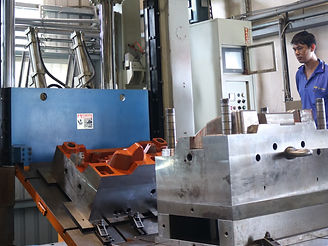
Howmin utilizes a vertical die spotting machine, operated by experienced technicians, to perform final precision polishing and mold alignment calibration for automotive lighting molds. Through repeated fitting cycles and blue dye contact inspection (red lead spotting), we ensure each mold achieves exceptional dimensional accuracy and surface contact precision. This process effectively eliminates risks such as burrs and flash, preventing issues like material leakage and parting line defects during injection molding. As a result, it significantly improves production consistency, yield rate, and overall mold performance in mass production.
See how this process delivers results:
explore our automotive tail lamp, motorcycle lamp, and grille mold case studies.